The IT department is working on a new core system designed with all the principles of deterministic thinking in mind. However, a GenAI component is now to be integrated that makes probabilistic decisions during day-to-day operations.
Suddenly, the entire project faces a challenge. How do we test a system that does not always produce the same answer? How do we guarantee security when the logic is not fixed? The usual software development processes no longer apply. Managers must now understand that the uncertainty inherent in AI is not a risk, but a breeding ground for innovation.
Contents
- From ‘island’ to ‘ocean’ thinking: established structures breaking down
- A change of perspective: Saying goodbye to the illusion of determinism
- Mindset upgrade: Language skills become IT skills
- Human and machine: co-creation as the norm
- The joy of shaping the AI transformation: The way forward
From ‘island’ to ‘ocean’ thinking: established structures breaking down
Organisations have traditionally relied on tried-and-tested, robust processes. Until now, the aim of digitalisation has been to create ‘islands of order ’: clear process models, structured data and defined rules. Anything that did not fit into this rigid framework – exceptions, uncertainties, human judgement – remained in the vast grey area that had to be dealt with manually. And this work is predominantly carried out using a central tool: our human language.
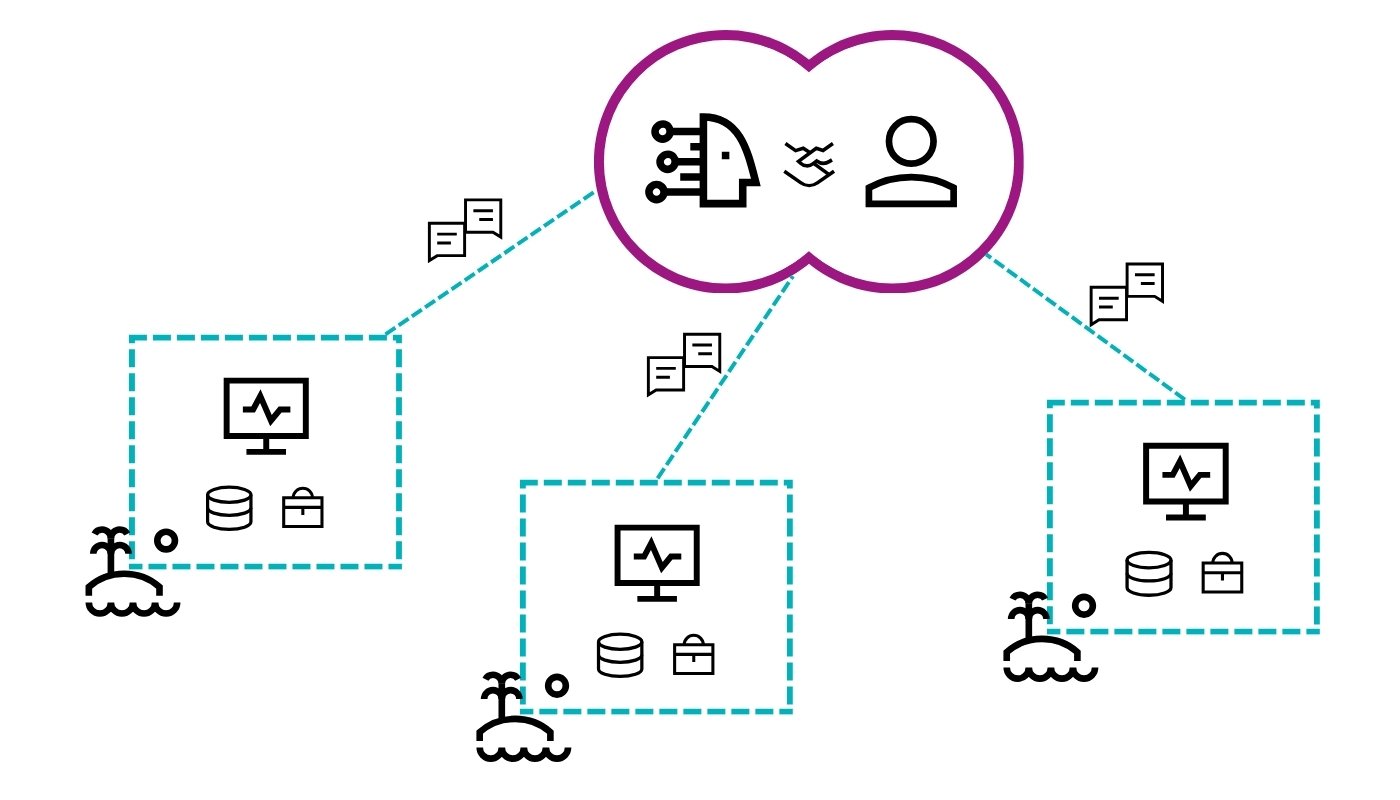
However, Generative AI (GenAI) is flooding these gaps thanks to its disruptively new ability to operate within the semantic space of human language. The familiar world of IT, with its clear boundaries, is giving way to a dynamic VUCA (volatility, uncertainty, complexity, ambiguity) world.
The technology is no longer confined to structured islands but is now operating within the ocean of ambiguity, which until now had been navigated exclusively by us humans.
It is precisely in this shift away from traditional yes/no logic that the opportunity lies. AI works productively with ambiguity when we dare to break out of ingrained patterns.
A change of perspective: bidding farewell to the illusion of determinism
Those who fear complexity will be left behind. Those who embrace it will discover innovation. As AI breaks down old paradigms, unprecedented scope for innovation emerges.
The core problem: until now, software has been deterministic. The same input always led to the same output. With GenAI, however, probabilistic systems are making their way into businesses. They think for themselves, vary their approach and adapt. The traditional approach – months of analysis, specifying every detail – no longer works here, as the result can no longer be predicted with 100 per cent certainty.
The new path to innovation:
- Rethinking quality assurance: How do you test a system that responds slightly differently each time? Rigid test protocols are giving way to an assessment of quality and plausibility. Security and compliance must be redefined in a non-deterministic environment.
- AI-supported prototypes: Using Minimum Viable Products (MVPs), teams gather feedback from real-world usage scenarios within days, rather than spending months at the drawing board.
- Iterative learning: Rapid corrections and learning whilst the system is in operation are replacing the need for a perfect specification.
Leaders must make the most of this time. Setting up AI labs is becoming essential in order to gain experience with this new ‘non-linearity’. Teams need the freedom to test and to fail quickly.
Mindset upgrade: Language skills become IT skills
AI demands a new way of thinking from management and teams. One of the biggest surprises of the current revolution is the role of language. It used to be the exclusive tool humans had for managing complexity. Now, natural language is becoming the universal interface between humans, machines and data.
The new leadership DNA requires:
- An understanding of subjectivity: Anyone building AI systems must understand that the machine’s responses have an impact on the user – even on an emotional level. A purely technically correct response is no longer enough; the ‘tone’ of the software is becoming a hallmark of quality.
- Agility rather than a master plan: As AI models are evolving rapidly, agile pilot projects are replacing rigid five-year plans.
- Curiosity as the norm: Leaders do not wait for the next industry standard, but proactively experiment with new language-based possibilities.
Success also depends on interdisciplinary collaboration. Complex challenges can no longer be solved by technical means alone. Involving colleagues from all departments at an early stage ensures domain expertise and broad acceptance.
Human and machine: co-creation as the norm
The relationship between people and technology is being redefined. AI no longer acts as a silent background process, but as an active sparring partner. This requires a reorganisation of the distribution of responsibilities within teams.
Managers are now creating open spaces for dialogue. In this context, leadership means incorporating different perspectives and fostering a climate in which specialist knowledge and experience converge.
The new team structure:
- Interdisciplinary dialogue: This is crucial in AI projects, as no one can grasp the full picture on their own any longer. Linguistic understanding meets hard coding.
- Fluid structures: Small, dynamic teams are forming, comprising developers, industry experts and user representatives. Rigid silos have had their day.
These teams develop prototypes, learn from one another and continuously adapt solutions. They form a collaborative system combining human experience and algorithmic power.
Emotional intelligence remains the key competence. AI is no substitute for empathy. It is up to leadership to establish a culture of trust and to use technology as a lever for shared success.
The joy of shaping the AI transformation: The way forward
Managers have rarely had so many opportunities to shape the digital transformation themselves, because:
- The ambiguity of AI brings the era of pure yes/no logic to an end and enables more flexible, adaptive solutions.
- Natural language is becoming the most powerful code of the future.
- Emotional intelligence and interdisciplinary co-creation define the new leadership qualities.
The real art lies in understanding uncertainty as a playing field for smart decisions. What counts is taking the first step into the unknown, iterative learning and team progress. Leaders who place their trust in their teams set the pace.
Change now demands bold leadership to successfully guide the organisation into the future.
This blog post is based on our book *When is it good enough? – Software Projects in the Age of Generative AI*. You can find more information and a link to the book here.
Do you have any questions or need assistance?
Ambiguity opens up new avenues in software development, but it also presents your team with fundamental strategic questions.
You can find further information on how to manage probabilistic AI projects effectively, as well as our approaches to agile leadership during times of change, on our website. Feel free to contact us directly – our experts will help you master this uncertainty.