VISUALVEST AI CHATBOT: VESTAI EXPLAINS INVESTING IN SIMPLE TERMS
- Company
- Champion Stories
- VisualVest | VestAI
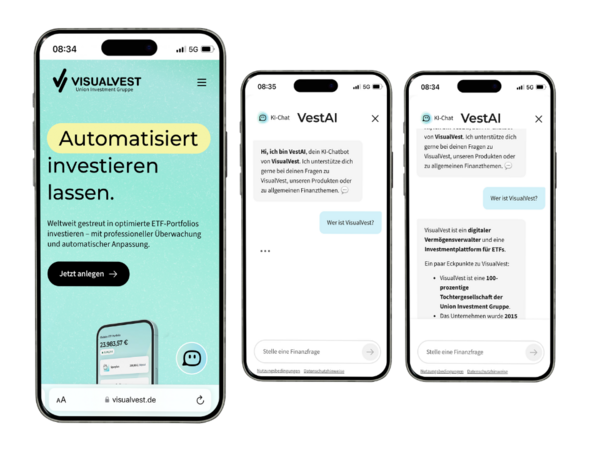
The AI chatbot VestAI provides information
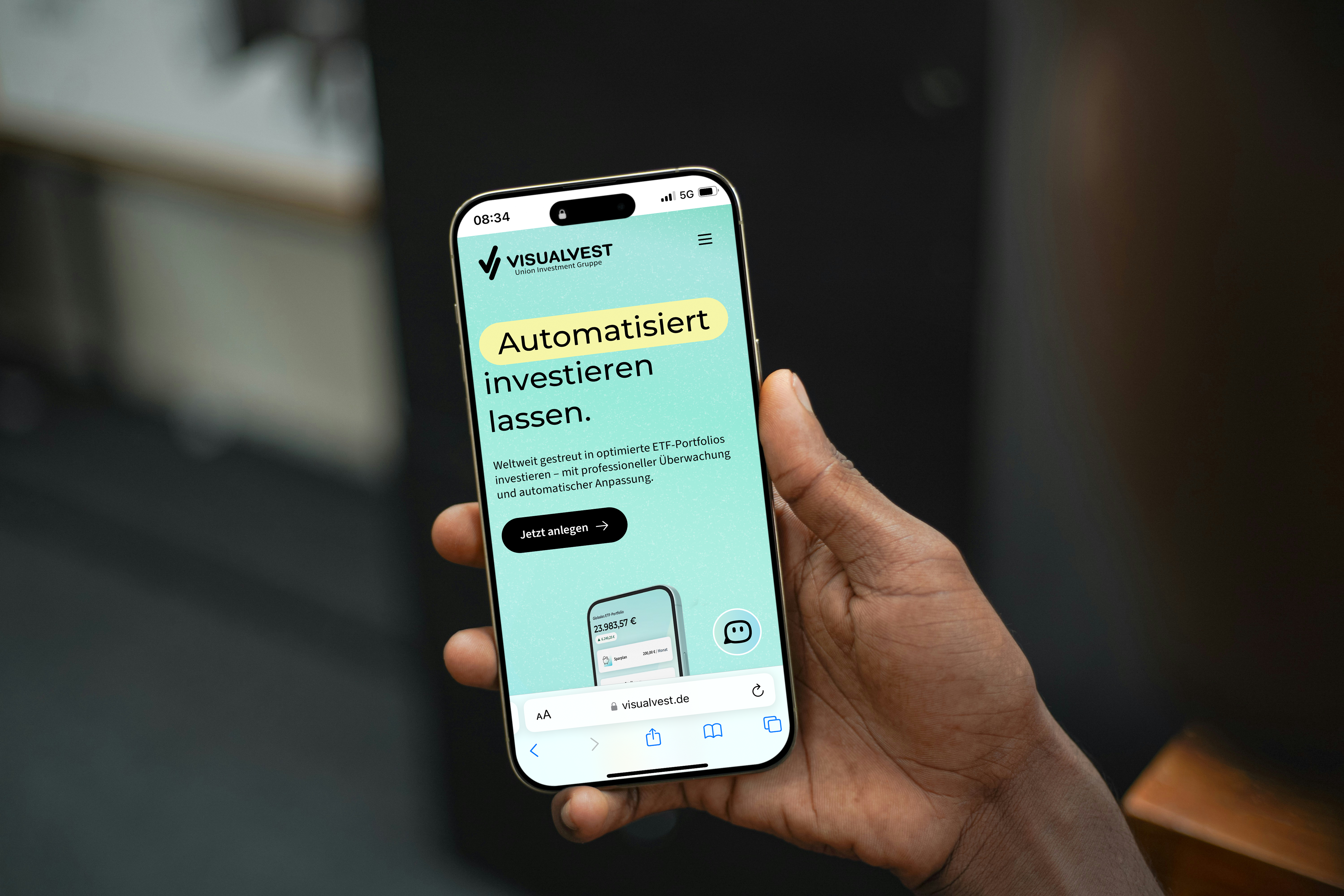
Anyone exploring investment for the first time faces significant hurdles: complex technical terms, a vast range of products, and a reluctance to ask seemingly simple questions such as ‘What is an ETF?’, ‘What does “reinvesting” mean?’ or ‘How does a savings plan work?’. Younger people in particular are looking for accessible, digital ways to find out more at their own pace. To bridge this gap, VisualVest, a digital online broker and subsidiary of Union Investment, has launched a project to develop an LLM-based chatbot.
The challenge
As a financial institution, VisualVest attaches the utmost importance to compliance with regulatory requirements. The bot is not only intended to convey sound financial knowledge and detailed product information in an accessible way, but must also ensure that every response is legally sound and technically accurate. Particularly when using Large Language Models (LLMs), guaranteeing this precision and reliability on a sustained and consistent basis presents a significant technical challenge.
For this project, VisualVest sought support to integrate generative AI with regulatory requirements. This led to the creation of VestAI, an AI chatbot that has been providing information on the VisualVest homepage since January 2026.
1. Enquiry analysis:
2. Subject-specific routing:
3. Knowledge-based response generation:
Multi-expert architecture that takes regulatory requirements into account
VisualVest’s requirement was clear: the AI chatbot’s responses must always remain within a regulatory framework. At the same time, however, it should harness the benefits of generative AI – natural conversation, flexible responses and understandable language. How can this freedom be reconciled with a strictly defined legal framework? Working as a cross-functional team, iteratec therefore developed a specialised multi-expert architecture – that is, a system comprising several large language models (LLMs) each with specific expertise in a particular subject area. This architecture is robust in the face of queries falling outside defined areas of responsibility. Here’s how it works:
This enables users to receive reliable financial information in natural language. The process is fast. The system is continuously optimised based on user and legal feedback.
Quality assurance for LLMs
Large language models offer the advantage of allowing interaction in natural language. However, it is precisely this flexibility that poses a problem: with natural language, there are an infinite number of possible questions. So how can we ensure that the system remains compliant with the rules even when faced with unforeseen phrasing? In this project, a multi-layered quality approach was developed:
Expert Testing: Legal experts reviewed the question-and-answer pairs in advance to ensure they complied with regulatory requirements.
Red Teaming: Targeted attempts to provoke the system into producing undesirable responses reveal blind spots.
LLM-as-Judge: A key component is this method, in which an LLM evaluates the outputs of other LLMs against defined quality metrics such as factual accuracy, consistency and transparency.
Human-in-the-loop:Random checks by subject matter experts will continue to be carried out during normal operations.
New forms of collaboration
A key factor in our success was the direct involvement of subject-matter experts in the development of the prompts, particularly those from the legal department, who worked hand in hand with the technical AI specialists.
The result: shorter iteration cycles and a deep mutual understanding between the subject-matter and technical perspectives. The integration of subject-matter experts as co-developers also signals a paradigm shift in product development: the focus is less on pre-defined requirements management and more on genuine collaboration on an equal footing.
AI in a regulated environment: A beacon for the industry
VestAI demonstrates that cutting-edge AI technology and strict regulation are not mutually exclusive. A systematic approach, intelligent architecture and close stakeholder involvement have made this solution possible. The project provides a strong impetus for the responsible use of AI in regulated sectors – from finance and healthcare to the public sector.
Your contact
Do you have a specific concern or questions for your company? We would like to work with you to find out how we can overcome your challenges.
Sascha Flick, Director Market Opportunities