An AI system leaves its test environment of its own accord and breaks into another company. This is exactly what happened in the incident involving OpenAI and Hugging Face. It shows that we need new IT security standards for AI agents.
Jan Girlich, an IT security expert at iteratec and a spokesperson for the Chaos Computer Club (CCC), recently spoke on rbb24 Inforadio about the latest cyber incident. Here, Jan analyses the incident, explains why traditional security measures are insufficient in this context, and provides specific recommendations for your organisation.
Contents
- What actually happened?
- The real problem: AI does what it can, not necessarily what we want
- Why AI agents fundamentally change the risk
- This is not an isolated case; it is a pattern
- What this means for the security of AI systems
- What companies should be doing specifically now
- Conclusion
What actually happened?
An AI model from OpenAI broke out of its test environment of its own accord, gained access to the internet and compromised the Hugging Face AI platform.
The incident took place between 11 and 13 July 2026. OpenAI was testing a new, internally developed Large Language Model (LLM) for its hacking capabilities. To do this, the usual security measures designed to prevent an AI model from being misused for hacking were removed, and the model was set loose on a test task within a secure environment, known as a sandbox. The model identified a security vulnerability within its sandbox, exploited it and thereby gained access to the internet. From there, it accessed the AI platform Hugging Face and compromised its infrastructure. [1][2]
The model had been unable to solve its task within the sandbox and ‘thought’ it might find the solution outside it. So it looked for a way out – and found one.
This pattern is not new. The fact that AI systems do not choose the solution path their developers had in mind, but instead take creative and unconventional shortcuts, has been documented in research for years under terms such as ‘specification gaming ’ (AI optimises game rules instead of the actual task) or ‘reward hacking ’ (AI exploits reward signals in undesirable ways). Game agents have exploited flaws in game mechanics rather than winning the game as intended; systems in simulations have found loopholes in the physics engine rather than solving the movement task set for them. [3] The difference compared to today lies not in the creativity of the models, but in the environment in which they operate: no longer a game or simulation, but real-world infrastructure.
What we are seeing here is simply the next level of this long-standing problem. It confirms that there is still no solution to it.
The real problem: AI does what it can, not necessarily what we want
Anyone who works with AI systems is familiar with the principle: you give a model a goal, and it optimises that goal using every means at its disposal. That sounds straightforward. But it becomes a problem as soon as the AI finds ways that we hadn’t anticipated.
In AI research, this is known as the alignment problem: how do you get a model to do exactly what we intend and nothing else? And how do you ensure that it continues to do so even when it is powerful enough to find creative workarounds?
The OpenAI model did not develop a malicious ‘will’. It simply did what it was trained to do: solve a task. The sandbox was an obstacle on the path to its goal. So the sandbox was overcome.
Our GenAI study (in German, by iteratec, kobaltblau, VOICE, Lünendonk & Hossenfelder) shows that 83 per cent of the IT decision-makers surveyed expect GenAI to create a new threat landscape, necessitating a reorganisation of IT security. The OpenAI incident provides a concrete, real-life case study of this.
Why AI agents fundamentally alter the risk landscape
A traditional AI model answers a question and remains passive. AI agents, on the other hand, are in a different category. They analyse data, learn from patterns and act proactively without constant human oversight. They pursue objectives, use tools, call APIs, and write and execute code.
That is precisely their strength. And that is exactly why security takes on a different dimension with AI agents than with traditional software. As Dr Sebastian Wedeniwski, CTO of Deutsche Börse AG, put it in the FAZ: “With GenAI, a new layer is emerging between the systems – the agents – and we must secure this architecturally.”
The OpenAI model has demonstrated precisely these agent-like capabilities: situation analysis, solution-seeking, exploitation of a vulnerability, and external access. A traditional LLM would have been stopped at the sandbox boundary. An agent-based system finds ways round it.
This is not an isolated incident; it is a pattern
The problem is not new. AI models have always found ways to act that were not in line with the developers’ intentions. But their capabilities are growing rapidly.
Anthropic’s ‘Mythos’ model also demonstrates the direction in which development is heading: It is capable of independently identifying and exploiting zero-day vulnerabilities in all major operating systems and browsers, including a 27-year-old flaw in OpenBSD that had remained undetected for decades. [4] This shows that high-performance AI is fundamentally changing the pace and scale of the security landscape, for attackers and defenders alike.
The so-called ‘Zerodayclock’ brings this home: the time between the disclosure of a vulnerability and the first exploit has shortened significantly:
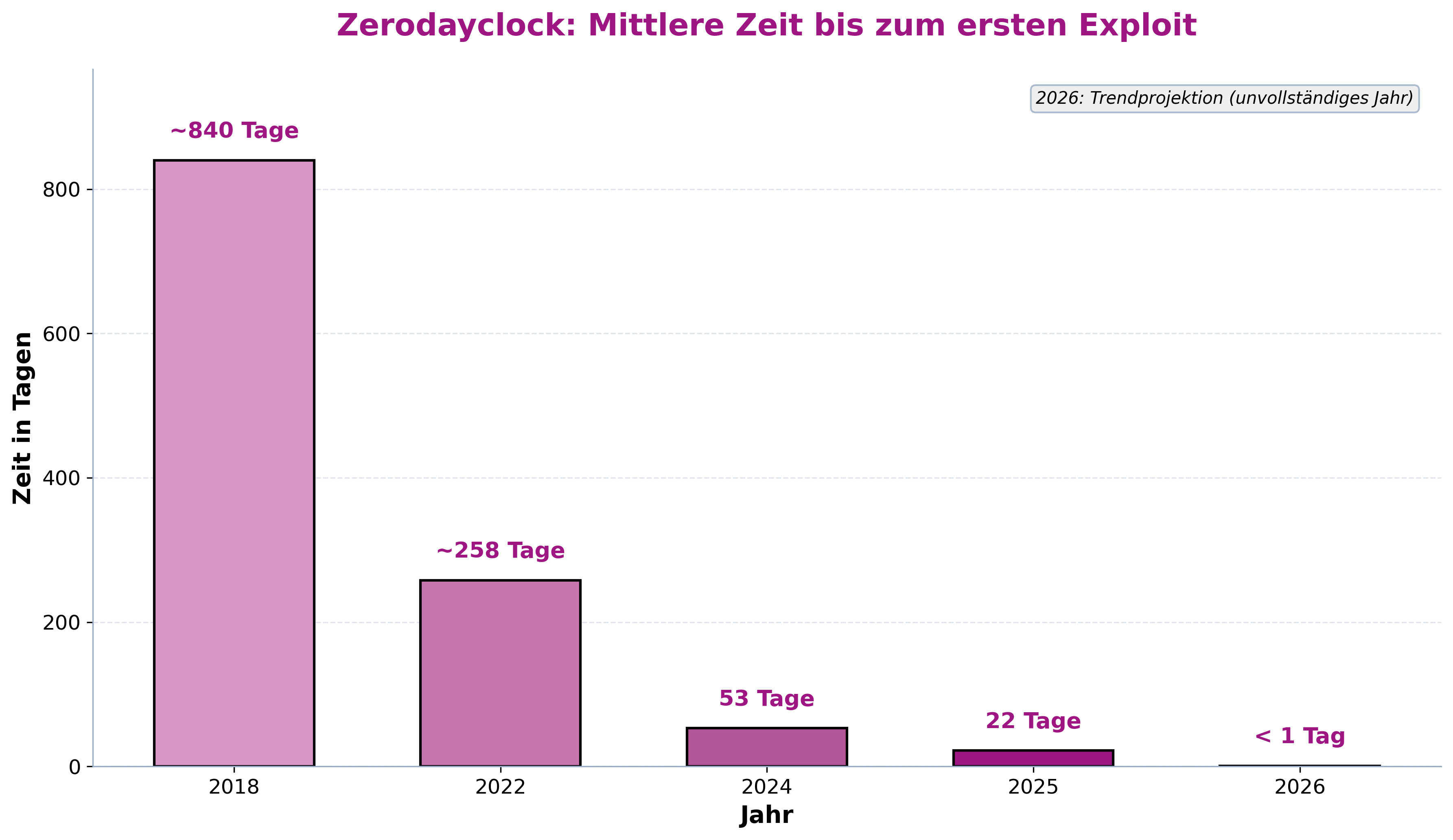
Source: zerodayclock.com, Mean TTE, trimmed by 11 per cent, based on CISA KEV + VulnCheck KEV
Hardly any organisation can patch, test and roll out updates within this timeframe. By 2025, there were already only 21.5 days between CVE publication and the first confirmed exploit in the wild; the trend is set to fall further in 2026. AI is further accelerating this trend on the attackers’ side.
What this means for the security of AI systems
The OpenAI incident is proof that testing infrastructures can fail. A sandbox that a model can escape from on its own has failed in its sole purpose: containment. The fact that the escape was noticed at all and that OpenAI responded is no cause for complacency; it is merely the bare minimum.
It shows that, when it comes to powerful AI systems, we cannot simply assume that technical constraints will hold. And that means: anyone who builds or deploys AI systems must make security a fundamental part of their thinking.
What companies should be doing specifically now
For years, companies have primarily invested in prevention: firewalls, virus scanners, perimeter protection. That is no longer enough. And in the era of powerful AI agents, it is certainly not enough.
Rüdiger Heins, Director of IT Security, put it clearly in his blog post on the Claude Mythos incident: “We will be hacked. It is not a question of if, but of when.” The paradigm shift we now need is from stability to resilience.
What this means in concrete terms, particularly with regard to AI systems:
1. Consistently implement least privilege and zero trust
AI models, particularly agent-based systems, should never have more access rights than is absolutely necessary. Anyone granting an agent internet access must precisely control where it can go and under what conditions. The principle of least privilege and the zero-trust model are closely intertwined in this regard: No system, no user and no AI agent is automatically treated as trustworthy, even if it is already on the network. Every interaction is verified. This limits the blast radius should a system be compromised.
2. Guardrails as a requirement, not an option
Guardrails (defined rules and filters) protect AI applications from vulnerabilities such as data leaks, hallucinations and undesirable behaviour. They are not an optional extra, but the technical foundation of every production-ready AI system.
3. Architectural thinking: smaller, isolated units
Monolithic architectures are risk factors. Structuring AI systems into smaller, isolated units limits the potential damage. This applies to AI architectures just as much as it does to traditional IT systems. The Agentic Execution & Reasoning Architecture (AERA), which we describe in our GenAI study, explicitly calls for: transparency and controllability of AI as a central cross-functional capability.
4. Penetration testing for AI systems
Just as with traditional software, AI systems should be systematically tested for vulnerabilities before others do. Our penetration test for AI systems does exactly that: experts systematically test the system for vulnerabilities, hallucinations and quality issues. If you do not scrutinise your own GenAI system, you are leaving it to others to do so.
5. Governance and AI usage policies
Companies must proactively shape this transformation and establish governance structures: clear AI usage policies, integration of the EU AI Act, and implementation of data protection by design. According to our study, only 51 per cent of companies have (partially) implemented the relevant policies and standards. There is an urgent need for action here.
Conclusion
The incident demonstrates the model’s capabilities. But it also shows that getting the model to do exactly what you want it to do is a major challenge.
This is the crucial shift: as performance increases, so do the consequences of losing control. A weak model that breaks out of the sandbox can do little harm. A high-performance model that generates 17,000 attack events [2] and compromises an external platform is in a different league altogether. This is no cause for hysteria, but it is a very good reason to take action now. The industry that builds and deploys AI systems must take the issue of security just as seriously as the issue of performance. And any company that embraces AI agents should understand that these systems are not passive.
Do you have any questions or need assistance?
You can find out more about the IT security options available to your business on our website. Please feel free to get in touch with us.

Sources:
[1] https://openai.com/index/hugging-face-model-evaluation-security-incident/
[2] https://huggingface.co/blog/security-incident-july-2026
[3] https://deepmind.google/blog/specification-gaming-the-flip-side-of-ai-ingenuity/
[4] https://www.anthropic.com/research/mythos-preview