With eyond, we are demonstrating that electric mobility can be more than just emission-free driving – it is becoming an active component of a smart, stable and affordable energy system. Together with iteratec, we are laying the technical foundations for our OEM and utility customers, enabling them to harness the enormous storage potential of electric cars for the energy transition – starting today and scalable for the future.
THE MOBILITY HOUSE ENERGY: AN INNOVATOR IN THE ENERGY TRANSITION
- Company
- Champion Stories
- Mobility House Energy | eyond App
How e-mobility can contribute to a climate-neutral electricity supply
For the energy transition to succeed, more is needed than just renewable energy. The electricity grid must remain stable at all times, even when the wind isn’t blowing and the sun isn’t shining. As the share of renewable energy increases, generation becomes volatile. Under these conditions, batteries can help stabilise the grid and balance generation and consumption. This is precisely where The Mobility House Energy’s vision comes in: using electric cars as mobile energy storage units to offer emission-free and cost-free e-mobility whilst simultaneously stabilising the electricity grid. iteratec contributed to the development of eyond by providing technical consultancy and implementation support.
Harnessing electric cars as the world’s largest energy storage system
The number of registered electric cars on the roads is rising, and with it the potential of their vehicle batteries. When used as energy storage systems, electric cars can help stabilise the grid. For example, by feeding energy back into the grid at peak demand times and then charging when there is a surplus of electricity. The technology behind this is known as Vehicle-to-Grid (V2G).
This enables two things: firstly, it promotes climate-neutral mobility, as this solution allows renewable energy to be utilised in a targeted manner and integrated into the electricity grid. Secondly, users benefit from noticeably lower costs through smart charging at times when electricity prices are low – which is often when large amounts of renewable energy are being generated.
To turn this vision into reality, The Mobility House Energy entered the electricity trading market and sought a partner to support them with the technical implementation.
eyond App: Smart charging control via electric cars and charging points
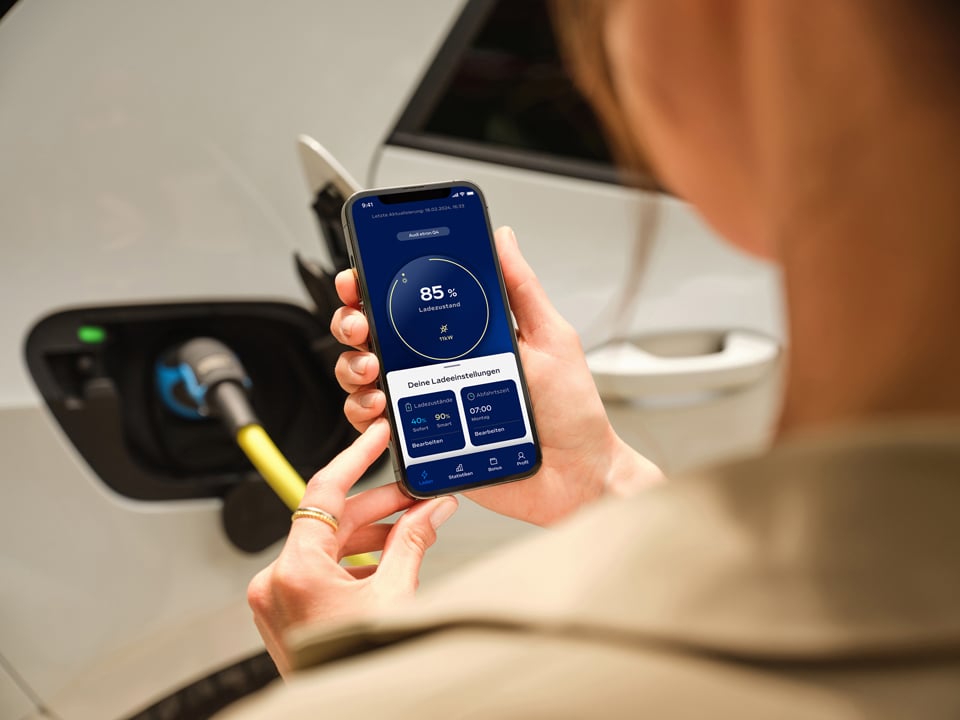
eyond is an electric vehicle charging solution – comprising a green electricity tariff and an app that enables customers to access green and affordable electricity for their homes and electric cars. Together with The Mobility House Energy, our colleagues at iteratec developed a key component of this solution: the eyond app.
How eyond works
Smart charging ensures that electric vehicles are charged automatically when electricity is particularly cheap. To achieve this, vehicle and charging point data is analysed in the background during the charging process and compared with individual charging targets. The charging control for the cars and charging points is continuously optimised by the underlying platform, which sources electricity from the electricity exchange.
Users benefit from guaranteed lower electricity prices whilst still having a fully charged vehicle ready at their desired departure time.
Marcus Fendt, CSO and Managing Director of The Mobility House
Award: German Innovation Award 2026
iteratec and The Mobility House Energy 2026 received the German Innovation Award for the development of the pioneering smart charging solution, eyond. This recognition honours their technological excellence and the sustainable impact on the energy transition.

From idea to solution
iteratec has supported The Mobility House Energy every step of the way, from the initial idea through to market readiness. Over the course of four years, we have jointly developed the end-user app and the associated backend, and created a scalable system architecture that combines smart tariffs with intelligent charging control, ensuring secure operation as customer numbers grow.
Today, eyond is successfully established on the market. On the one hand, The Mobility House Energy uses the solution itself for its own customers, whilst car manufacturers such as Renault also rely on the smart charging control and integrate the solution into their own infrastructure. Furthermore, eyond is used as a white-label solution by, amongst others, energy suppliers such as RheinEnergie AG. The solution is attractive to energy suppliers because smart electricity tariffs enable them to develop new business models and gain a competitive edge.
eyond is one of the first solutions on the market to combine the advantages of dynamic and fixed electricity tariffs and make them available to end customers in the simplest possible way. As a result, eyond customers benefit from a tariff with no price risk and have the opportunity to actively reduce their charging costs through controlled charging processes.
Outlook: E-mobility as a key component of the energy transition
The potential of eyond is far from being fully realised. In France, for example, Vehicle-to-Grid is already a reality and is being implemented by The Mobility House Energy in collaboration with Renault and Mobilize. In Germany, however, the regulatory framework required to use electric cars as temporary energy storage is currently still lacking. Overall, The Mobility House Energy has created a solution that not only improves security of supply in an increasingly volatile energy system, but also turns its customers into active participants in the energy transition – with the opportunity to benefit financially from it.
Laying the foundations: zero emissions at zero cost
With eyond and its consistent use of V2G technologies, The Mobility House is positioning itself as a digital pioneer in the field of dynamic electricity tariffs and smart charging infrastructure. The close collaboration with iteratec has laid the foundations for a scalable, flexible and forward-looking solution.
Flutter, Node.js, NestJS, KafkaJS, SNS/SQS, RabbitMQ, Enode API, PostgreSQL, Timescale, MobX, AWS, Datadog, Sentry, Keycloak
- Implementation of the app as a proof of concept to ensure feasibility. Subsequent further development to product maturity.
- Development of a highly asynchronous backend, including integration into the system landscape, in close collaboration with the client teams.
- Ensuring performance through load testing and operational reliability through monitoring.
- Testing innovative concepts for controlling vehicles and charging points as part of spike projects. Subsequent full-scale integration.
- Implementation of an end-user app to visualise charging processes and charging status, as well as support in defining the customer-specific UI/UX requirements.
- Development of a backend for charging control via the vehicle or charging point, as well as the calculation of customer bonuses relevant to billing.
The Mobility House Energy division is driving the energy transition by harnessing the flexibility of mobile and stationary battery storage systems. The company’s proprietary technologies form the foundation of its scalable solutions for energy suppliers, car manufacturers, CPOs and fleet operators. In this way, the company combines asset control, aggregation, optimisation and trading across various energy markets.