Every rail traveller in Germany is familiar with it: the small display above the seat on the ICE. Behind it lies a highly complex booking system that now processes many millions of enquiries every day. After more than 40 years, the legacy system has now been successfully modernised – a prime example of IT modernisation in large enterprises. The go-live took place six months ahead of schedule, with the system still running and without a single outage. In this interview, Karsten Will, technical project manager at Deutsche Bahn, explains how this was achieved and what role iteratec played in the process.
Mr Will, almost all rail passengers are familiar with the reservation display on the ICE or the seat selection feature in the Navigator. What lies behind this?
Behind it all was a system designed in the 1980s for just a few long-distance trains, which then grew exponentially. Until a few years ago, many European railways were using it. It managed not only regular trains, but also night trains, car trains, ships and even car parks. In the end, we were processing several hundred thousand bookings a day in a system that was originally intended for perhaps a thousand seats.
A technical marvel, but one that was becoming increasingly problematic: the hardware was no longer up to date, and the colleagues who could have maintained the system were gradually retiring. Operating this legacy system was therefore becoming increasingly risky – a classic problem with legacy systems. Modernisation was the logical next step in DB Long-Distance’s IT landscape.
The modernisation was a mammoth task that had to be carried out whilst the system remained in operation, without any disruption for millions of passengers.
Yes, that’s right. We had to continue processing bookings throughout the modernisation process. On top of that, there had already been two failed attempts at modernisation. But it was precisely those that showed us where the critical points lay. Today, the booking system has the heaviest-loaded interface in DB’s entire sales backend: our availability enquiry service. Every time someone opens the Navigator and accesses the enquiry service, a request is sent through our system for every single long-distance train in the connection overview. At peak times, this can amount to as many as 5,000 queries per second. Initially, even our monitoring frameworks were not designed to handle this level of load.
 |
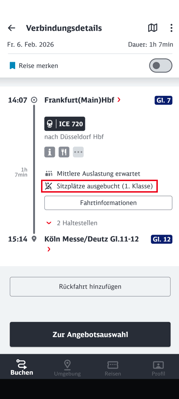 |
| Reservation display on an ICE train | Route selection in the DB Navigator app |
How did you tackle this?
The main task at the outset – for iteratec as well – was to properly break down the technical complexity so that the modernisation became manageable. In concrete terms, this meant filtering out of this system – which had grown over decades to include trains, ships, car parks and European railways – exactly what we would definitely do and what we wouldn’t. That’s very challenging because you constantly have to say no. But it was precisely this clarity at the outset that laid the foundation for our success. Without this groundwork, we would have been overwhelmed by the scope of the project.
Furthermore, we consistently applied traditional risk management. Using a proof of concept, we tackled the biggest risks first, so that after six months we could have abandoned the project or changed course if the technological approach hadn’t worked. But it did work.
In the end, we were even able to complete the project six months ahead of schedule.
Which risk concerned you most personally as project manager, and how did you bring it under control?
Data availability and accuracy. Imagine if we’d sold a seat twice because data hadn’t synchronised or had been lost during the transition from the old to the new system. Then two passengers would be sitting in the same reserved seat. That would inevitably lead to conflicts. With several hundred thousand transactions, an error like that simply cannot be allowed to happen.
 |
 |
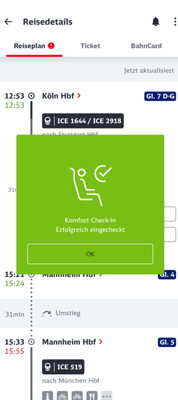 |
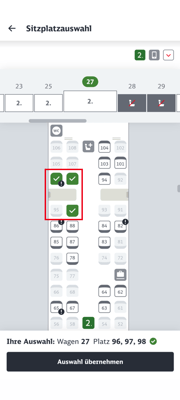
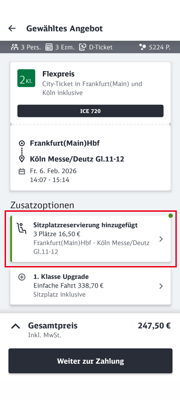
| Seat selection, fare selection and convenient check-in in the DB Navigator app | ||
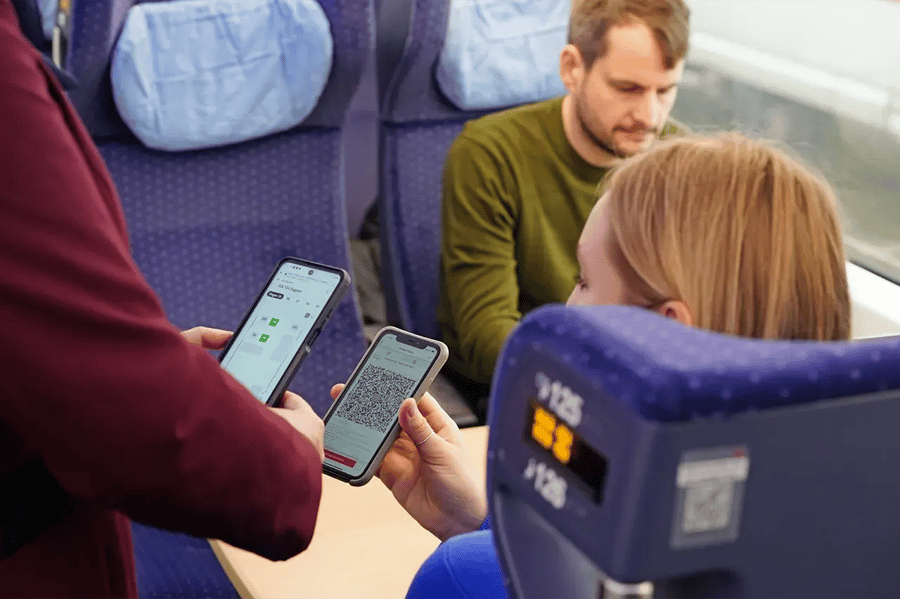
That is why we took a strictly incremental approach and started with non-critical use cases, such as the availability check on bahn.de to see whether a train still had seats available for reservation. This allowed us to test the entire data foundation step by step and learn a great deal about data quality. Other less critical features followed, such as graphical seat selection or the comfort check-in. When it came to the actual booking of reservations – the critical part – we proceeded train by train: First one train a day in the new system, then ten, 50, 100. If anything had gone wrong, the impact would initially have been limited. In the end, however, we didn’t have a single failure in the booking process.
You had over 40 people from various service providers working on the project. What role did iteratec play in this success?
The key factor was the technical leadership right from the start. iteratec provided the technical project manager, the lead architect, lead developer and quality lead – so we were well-equipped from the outset. For example, iteratec’s lead developer maintained consistent standards across all teams and ensured communication between the development teams. That was worth its weight in gold. New microservices were set up within hours, and the pipeline was never a problem. This technical consistency was the cornerstone of smooth collaboration; even towards the end of the project, when we had to reorganise our teams every three months to balance the workload.
💡Previously, Deutsche Bahn had also modernised its sales system in collaboration with iteratec. Read more about it in this blog article.
But the mindset was at least as important. The colleagues in key roles brought a way of working to the project that was infectious. We had nothing but people on the project who were committed. Everyone made it their own project. The iteratec colleagues played a major part in shaping this spirit, but everyone was fully on board. The fact that we’re now bringing all our iteratec colleagues on board for follow-up projects – even in economically challenging times – is, for me, the strongest proof of our satisfaction.
The project was completed six months ahead of schedule, with a 10 per cent saving on the budget, whilst the scope was actually expanded. But what specific benefits does the modernised booking system offer customers?
The travel experience, in terms of bookings, has improved across the board. This starts with the 5,000 enquiries per second mentioned at the outset, which we respond to in under 50 milliseconds, showing which trains still have seats available for passengers, bicycles, wheelchairs and so on. For many customers, this is a decisive factor in their decision to book.
Seat suggestions are more intelligent: families are given priority for seats in the family area, solo travellers in the quiet zone, groups in the open-plan area, and so on. More people are successfully booking their reservations because the error rate has fallen dramatically compared with the old system: In the old system, the numerous last-minute timetable changes could not be updated manually quickly enough; we now do this entirely automatically. The check-in rate is higher, seat availability displays on the train are more reliable, and much more. All of this contributes to a noticeably better travel experience and, consequently, to customer satisfaction.
And what impact does the project have on Deutsche Bahn?
We have created a system that runs much more stably, is easier to operate and, in the cloud, only uses the resources we actually need, enabling us to save on operating costs. Strategically, we are creating a platform for the future on which we can continuously develop new features. We now have a foundation for innovations that were impossible in a 40-year-old system.
Looking to the future: what does this sub-project mean for DB’s digital strategy?
The modernisation of the booking system is part of a major IT modernisation programme at Deutsche Bahn. This also included the complete modernisation of the sales system, which we launched in 2023 in collaboration with iteratec. Overall, we are creating a modern digital ecosystem at Deutsche Bahn.
What many people don’t realise is that Deutsche Bahn is carrying out software development at a world-class level here. A former colleague once told me: ‘What you’re doing here is Champions League standard. Outside, it’s the regional league.’ iteratec has played an active role in shaping this standard. We are now taking this expertise and these proven teams with us into further modernisation projects.
Do you have any questions or need support?
You can find out more about the possibilities of IT modernisation for transport and logistics on our website. Please feel free to get in touch with us.