Beijing, Shenzhen and Shanghai provide striking examples of how we will live in the future. In some places, city centres are remarkably quiet because so many electric cars are on the road; on selected routes, drones deliver parcels; and anyone who needs a nasal spray whilst on the train can order it via an app. At the next station, a courier will be waiting on the platform. It is quite possible that robots will soon be working there too, as China is a leader in robot development. In the first half of 2026, around 19,400 humanoid robots were shipped worldwide, over 97 per cent of them from Chinese manufacturers [1]. However, the most exciting market for robotics will be Europe.
Contents
- Why we went to China
- Why robots make economic sense in Europe first
- What we saw in China: three observations
- Why Europe must retain data from real work
- What I’m advising companies to do now
Why we went to China
Once a quarter, we at iteratec organise a Grand Challenge. Together with clients, partners and experts, we select a topic for the future and explore its potential. This time it was robotics, because in the human-agent teams we are building today, robots will also be working alongside us in the long term.
At the end of October, we therefore travelled to China with a group of European companies. The country recognised early on that robots contribute to several strategic objectives at once. They help to offset the ageing workforce, make the country less reliant on foreign technology and secure industrial leadership. The timing of the trip was good, as mass production is only just beginning and many Chinese companies are raring to go. We were able to visit seven of them, including AGIBOT, Linkerbot, AI2 Robotics and Astribot. Our hosts were very open, partly because they see Europe as a sales market.
Why robots make economic sense in Europe first
Before the trip, I viewed robots as an exciting technology. Now I see, above all, a business case. In China, there is less of an urgent economic need for robots: there is still a large workforce that is comparatively cheap. The average manufacturing wage there is around 7 euros per hour [2], whilst an hour’s work in the manufacturing and service sectors costs around 45 euros in Germany [3]. At the same time, we are facing a shortage of skilled workers. In the first quarter of 2026, there were around 1.15 million job vacancies in Germany [4].
In the past, an industrial robot could easily cost 100,000 euros, and integrating it into a workstation could easily cost many times that amount. That rarely added up. Now, several developments are converging: the hardware is becoming cheaper, and with AI, it is becoming apparent that robots will in future be able to learn without months of individual training. This is shifting where the costs arise. In future, it will no longer be the device itself that is expensive, but the process of adapting it for a specific task in a specific business. This is where the business case is decided, and this is precisely where the gap still lies today.
My theory is that Europe will become the largest market for the use of robots. The first robots with a proven return on investment will be deployed where labour is hardest to find and most expensive.
What we have seen in China: three observations
Hardware is no longer the bottleneck
The robots we saw are well-built. Behind them lies a dense ecosystem of suppliers located in the immediate vicinity, providing motors, joints, chips and, increasingly, robotic hands. This enables a rapid pace of development. Within two weeks, the teams can iterate a new hardware version of a robot.
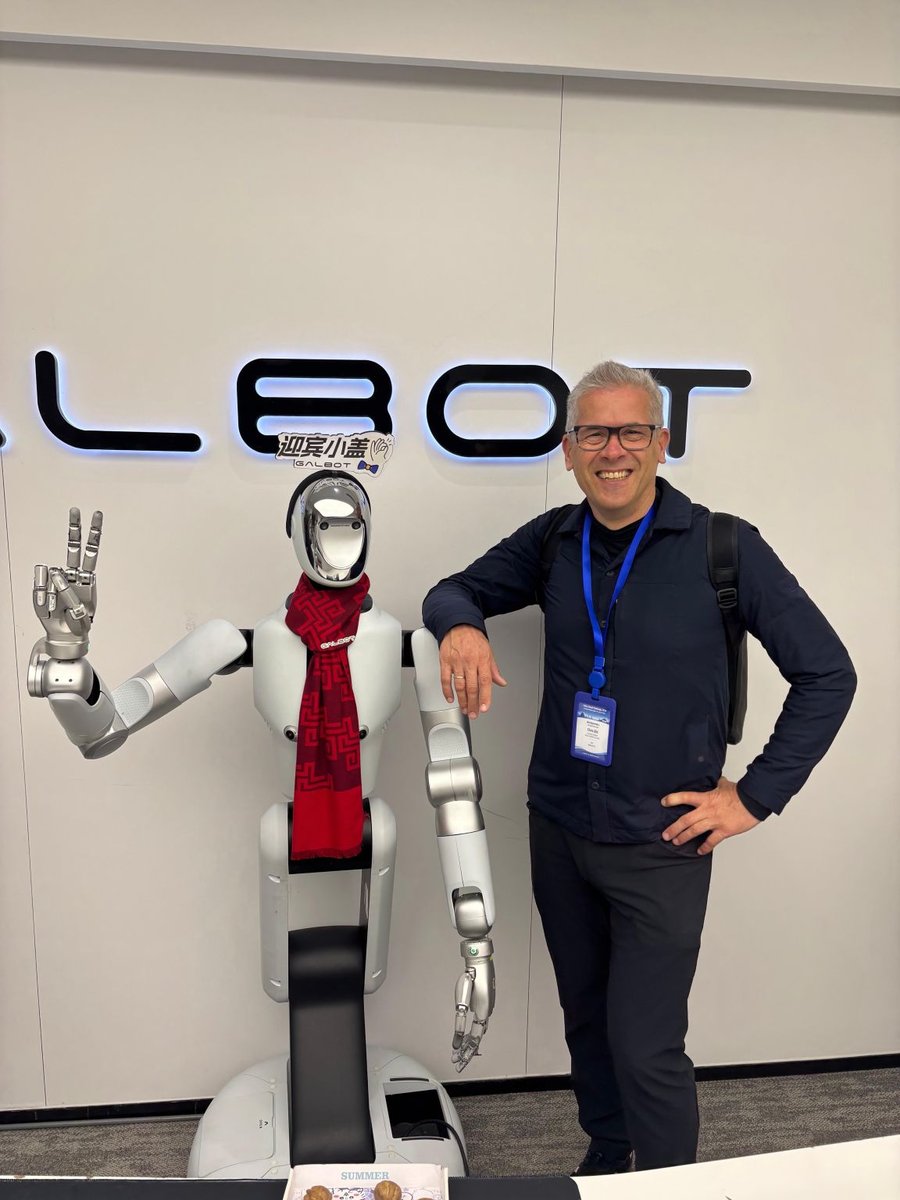
Video: A Galbot robot in a shop in China.
But the culture of embracing mistakes also allows for a faster pace. The demos were run live. If a grip went wrong or a robot came to a standstill, the hosts would reset it and restart it, right before our eyes and using early-stage software. In Germany, hardly any company shows visitors a half-finished stage of development.
The cerebellum works, but the cerebrum is missing
When it comes to robot intelligence, it is worth distinguishing between two levels. The cerebellum, which controls the body in terms of balance, movement and fine motor skills, is already functioning very well. The robots tighten screws and perform fine motor tasks that were unthinkable just a few years ago.
What is missing is the cerebrum – in other words, the understanding of what to do in a specific situation. The dance videos circulating online show rehearsed routines. If you ask the robot to perform a different dance, it fails. Robotics has yet to make the leap that we have experienced with ChatGPT or Claude in the field of language.
A body that dances steadily therefore says little about the mind. On a scale of five levels of autonomy, I see the industry today at level one, on its way to level two: individual, learnt skills that can cope with minor deviations. In my estimation, true task autonomy in a familiar environment, such as a warehouse, is five years or more away.
Training robots manually does not scale
How does a robot learn today? A scenario from a pharmacy might illustrate this, in which a robot retrieves medicines from a cupboard. It has to learn each pack individually, whether round, square, stacked or askew. So a person sits in front of it and trains it on every variation, often via remote control or using an exoskeleton arm. In China, many people are teaching robots different handling techniques. A single gripping movement can take hundreds of hours to master. This is the current state of the art – in China, on a scale that no one else can afford.
This is not a viable model for Europe. We do not have the manpower to teach robots movement by movement. We need intelligent algorithms – that is, AI models – that can think abstractly; models that can, for example, recognise a tin, estimate its weight, grasp it and know what happens to it next.
Taken together, this means that the development of the robot’s body has largely been solved, but its ‘mind’ has not. The next major advances in robotics will therefore come from software, from AI models capable of abstraction, and from the work involved in training them for real-world tasks.
Why Europe must retain data from real-world work
Robots are being deployed in places where people carry out manual labour – in factory halls, warehouses, hospitals, railway stations and retail outlets. This is not about full automation, but about collaboration.
For a robot to function in a specific company, it must be technologically integrated into that company and trained in its processes and safety requirements. It needs to be connected to the stock management system, production control or ordering system; it must behave correctly and be protected against tampering. At its core, this is the same task that companies are currently tackling with AI agents: integrating AI into existing processes and systems in such a way that it works reliably and, indeed, securely. The robot simply comes with a physical body as well.
Each of these deployments generates data that improves the next robot. Chinese manufacturers are well aware of this. They publish their software stack and some of their data as open source. The data from real-world deployments, however, remains in-house. For Europe, this means that whilst we can produce the physical robots, we should retain control over the use cases, the operational data and the ‘brain’ that learns from them. This is a question of digital sovereignty and also of our own competitiveness, because whoever has the operational data will develop the better robots.
What I’m advising companies to do now
I believe the next two to three years will determine who in Europe gathers the experience and data from real-world operations. I think three steps make sense:
- Choose a task. Ideally one for which it is already difficult to find staff today, and which is too variable for traditional automation, such as order picking, loading machines, restocking shelves, etc.
- Start small, but make it real. A robot that can reliably perform a single movement is more valuable than one that can do everything in a video. Define a success criterion and test it in your own operations.
- Keep the data. Before the pilot project, clarify who owns the operational data and where it is stored.
Europe can take a leading role in robotics; after all, we have the industry, the processes, the engineers and a high level of demand. Now we must start putting robots to work in real-world applications. For me, this is the logical next step in what we’re already doing with AI agents today: integrating AI into real-world processes so that it delivers measurable benefits.
Sources
[1] Smart Analytics Global
[2] Trading Economics
[3] Destatis
[4] Institute for Employment Research (IAB)
What is your AI based on?
Whether it’s an agent or a robot, AI needs a solid technical foundation. Talk to us about how to make your systems and data AI-ready.