
Building a platform involves far more than simply linking individual software products. But how can you make the transition from independent solutions to a flexible, scalable and user-friendly platform? This article takes you step-by-step through the strategy, architecture and practical implementation steps required for successful product integration – with concrete examples, tried-and-tested methods and strategic recommendations.
📖 Contents
- Starting point
- Define the target vision and strategy
- Develop an integration model
- Draw up an architectural blueprint
- Carry out an integration assessment
- Implementation in phases
- Establish governance and maintainability
- Establish effective support
- Conclusion and outlook
The transformation from individual applications to an integrated platform requires well-thought-out strategic planning. The overview presented here is based on over 25 years’ experience gained from numerous projects with clients of all sizes. This overview is intended merely as a basic guide; each aspect could be explored in greater depth.
Current situation
Many companies and start-ups begin with a core product and gradually expand their offering through additional software solutions, external tools and acquisitions. The result is often a heterogeneous landscape that can confuse users and lead to inefficient data management across different systems. An integrated platform with a unified user interface and cross-system processes, on the other hand, significantly improves the user experience and often opens up new opportunities for business models and cross-selling.
Define the vision and strategy
The transformation begins with a clear vision. This describes not only the technical objective, but also the economic and organisational benefits of the platform. An example: A healthcare group is planning to consolidate its various patient portals into a central platform. The aim is to provide a single login, standardised appointment management and seamless communication processes between doctors, patients and administration.
Key strategic cornerstones:
- Customer-centricity: Users should have a seamless, consistent experience, regardless of the product’s origin.
- Cost-effectiveness: Integration must not be an end in itself. Its economic viability must be reviewed regularly.
- Technological neutrality: Openness to different technologies, provided they fit within the platform strategy.
A frequently underestimated factor for success is the early involvement of all relevant stakeholders, from IT through to product management and support.
Develop an integration model
A scalable integration model provides a framework for the wide range of possible levels of integration. It offers a common language for project teams and helps with prioritisation.
Level 0: Standalone (separate systems with minimal integration) and UI linking (simple connections via links)

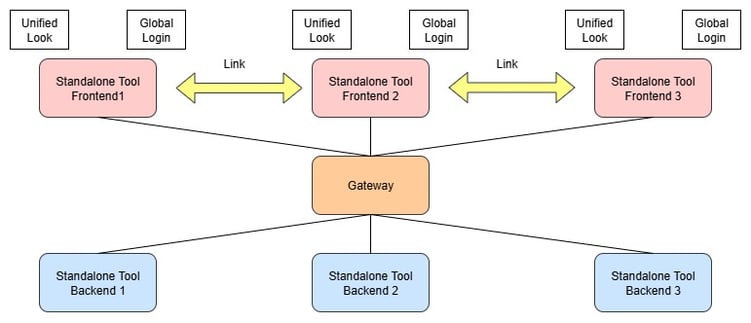
Level 1: UI/UX harmonisation and global login

Optional: Introduction of a gateway for greater flexibility. Loosely coupling the front-end and back-end
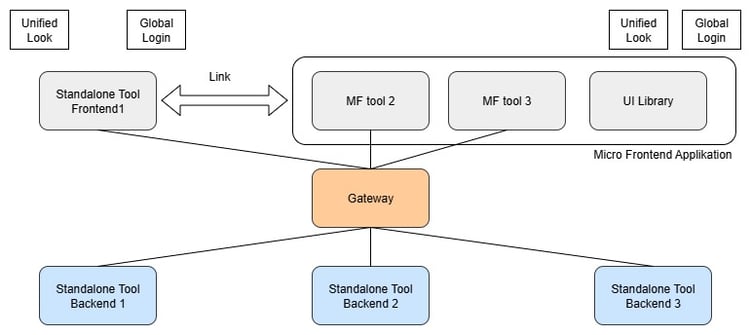
Level 2: UI embedding (front-end integration, e.g. micro-front-end)
Level 3: API integration (more in-depth communication at the backend level)
Level 4: Process integration (end-to-end functionality across multiple systems, e.g. workflows, BPMN)
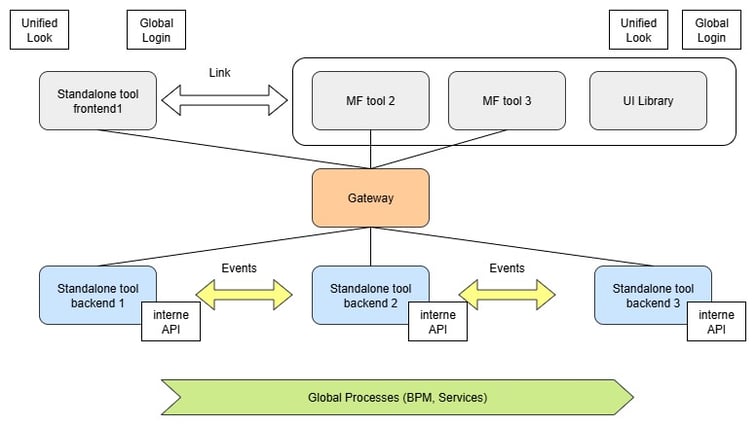
Level 5: Data model synchronisation (shared database or event-driven synchronisation)
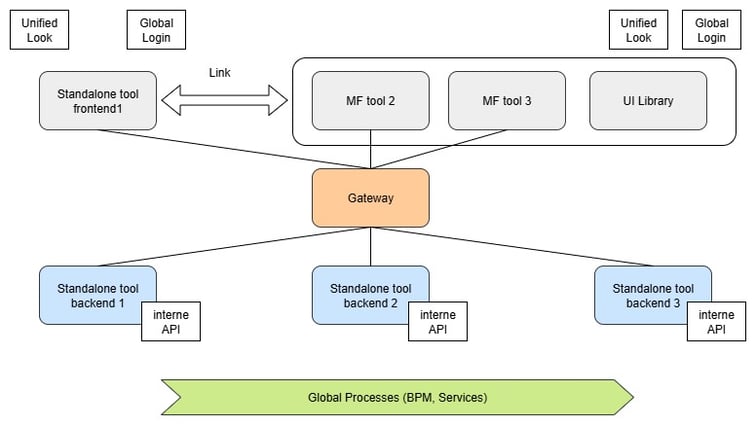
The higher the level of integration, the greater the benefits – but also the greater the effort involved. It is important to note that not every system needs to be raised to Level 5. Rather, each integration should be assessed on the basis of its strategic importance and usage.
A classic example of Level 3 integration is a financial platform that integrates modules from external banking services into its web interface via microfrontends. Process integration could take place on a supply chain platform, where orders are processed automatically across multiple systems.
Draw up an architectural blueprint
A platform architecture must be flexible, scalable and maintainable. The blueprint defines the architectural principles and key technical components.
Typical architectural building blocks:
- API Gateway / BFF (Backend-for-Frontend): Acts as an intermediary between front-end requests and back-end systems. Conceals internal structures and simplifies authentication and authorisation.
- Microservices & domain-oriented design: Support modular, independent development. Common patterns: self-contained systems, bounded contexts (DDD).
- Event streaming & message brokers: Technologies such as Kafka, MQTT or RabbitMQ enable decoupled communication.
- Centralised authentication (SSO): Keycloak, Okta or Azure AD ensure consistent identity management.
- UI shell / microfrontend host: Enables the dynamic integration and updating of individual front-end modules. Often based on Webpack Module Federation.
Real-world example:
A mobility provider uses a platform architecture with a central API gateway that interfaces with different BFFs depending on the channel (app, web, call centre). The UI has a modular structure, allowing partner features to be integrated as microfrontends – such as booking functions from car-sharing service providers.
Carry out an integration assessment
Not every integration makes sense. An objective assessment is essential for prioritisation. Key criteria:
- User value: To what extent does the UX improve?
- Technical effort: What system changes are required?
- Strategic importance: Is the system relevant for the future?
- Maintainability: How sustainably can the integration be operated?
Sample evaluation table:
|
Product |
Type |
Level |
Front-end integration |
Back-end integration |
|
In-house CRM development |
Self-hosted |
3 |
Microfrontend |
REST API |
|
SaaS analytics tool |
SaaS |
1 |
Link/iFrame |
Webhooks |
A suitable set of criteria not only helps with planning, but also with reporting to management.
Implementation in phases
A ‘big bang’ approach is rarely advisable. Instead, an iterative approach with clearly defined phases is recommended:
Phase 1 – Laying the foundations for the platform
- Setting up the authentication and role system
- Introducing the first platform components (header, footer, navigation structure)
- Technical MVP with at least one integrated system
Phase 2 – Vertical integration
- Integration of further systems at UI and API level
- Establish stable operational processes
- Implementation of CI/CD, logging and monitoring
Phase 3 – Process and data integration
- Process chains across system boundaries
- Shared data management (e.g. centralised customer profile)
- Automated data flows & event-driven synchronisation
Best practice:
An insurance company began by introducing a centralised login and a new, responsive platform interface. In a second phase, advisory processes were digitised and later expanded to include claims reporting, a document centre and chatbots – each implemented as loosely coupled modules.
Establish governance and maintainability
Well-established governance ensures the long-term stability and strategic direction of the platform. It forms the invisible foundation of every platform. The aim of governance is to guarantee consistency and reusability across product boundaries and to ensure technological and architectural coherence. This includes architecture reviews, decision protocols (ADRs), API guidelines, front-end design systems and comprehensive documentation. Clear quality management, regular architecture reviews and standardised development processes such as CI/CD are essential. Furthermore, established security policies and compliance requirements (e.g. GDPR, ISO 27001) ensure transparency and security in operations.
Key governance tools:
- Architecture/Lead Dev Boards: Regular assessment of technical decisions
- ADRs (Architecture Decision Records): Document architecture-related decisions in a traceable manner
- Coding guidelines and design systems: Promote consistency and maintainability
- API governance: Guidelines for versioning, documentation and backwards compatibility
Maintainability is the foundation for the platform’s longevity and adaptability. It begins with the architecture, which should be characterised by clear modularisation, an interface-oriented approach, low coupling and high cohesion. Practices such as Clean Code, Domain-Driven Design (DDD), automated testing and well-integrated CI/CD pipelines ensure that the platform can be operated flexibly and reliably. A well-thought-out logging and monitoring strategy provides continuous insights into operations and helps to identify potential problems at an early stage.
Ensuring maintainability through:
- Modularisation: Low coupling, high cohesion
- CI/CD & automated testing: Reducing sources of manual error
- Monitoring & observability: Early detection of problems
- Security standards: SSO, audit logging, GDPR compliance
A good example is a PropTech start-up that not only delivers features in every sprint, but also specifically evaluates maintainability: “Will this module still be understandable and deployable independently in six months’ time?”
Build effective support
High-performing support is crucial for ensuring user satisfaction and the stable operation of the platform. Well-structured support comprises various levels (layered support), ranging from first-level support, which handles initial user enquiries, to more specialised teams for complex technical issues. An on-call service (on-call engineers) is essential for quickly resolving critical system faults and keeping downtime to a minimum.
Structured platform support:
- First level: user enquiries, login issues, self-service portals
- Second-level: Product/module-specific experts
- Third-level: Developers or external service providers
- On-call services: Standby support in the event of critical failures
- SLAs and dashboards: Clear transparency regarding availability
In addition to clearly defined escalation procedures and responsibilities, effective service-level management (SLM) is essential. This involves defining and monitoring service-level agreements (SLAs), which set out clear availability and response times. Transparent dashboards and regular health checks ensure that both internal and external stakeholders always have a clear overview of the platform’s status. Self-service tools and comprehensive documentation enable users to resolve minor issues independently, thereby reducing the burden on support.
Reliable support is essential for stable platform operation and high user satisfaction. Support should be organised in a multi-tiered structure:
- First level: Receiving and pre-qualifying user enquiries
- Second level: Technical product support
- Third-level: Developers or external specialists
- On-call services: For critical faults outside business hours
Self-service options such as knowledge bases, interactive help tools and well-structured documentation reduce the workload on support teams and increase efficiency.
Service Level Agreements (SLAs), along with transparent dashboards and health checks, provide clarity on availability and response times – both internally and for customers.
Incident Management – Managing incidents professionally
Even in stable systems, incidents are inevitable. A clearly structured process is therefore essential:
- Prioritisation: e.g. P1 (critical), P2 (medium), P3 (low)
- Rapid response: Clearly defined procedures and responsibilities
- Transparent communication: internal status updates, external status pages
- Post-incident review (post-mortem): root cause analysis and identification of corrective actions
A central ‘lessons learnt’ archive helps to prevent recurrence. For particularly resilient platforms, chaos engineering can also be used to identify vulnerabilities at an early stage.
Conclusion
Developing an integrated platform is complex, but can be managed very effectively through a structured approach, clear governance and step-by-step implementation. It is important to remain open to adjustments and iterations and to learn continuously from experience. However, this overview offers only an initial insight – each of these points deserves its own in-depth examination.
Checklist for your platform transformation:
- Have you defined your vision and strategy?
- Have you classified the integration levels of your systems?
- Has a technical architecture concept been established?
- Have integration decisions been assessed and prioritised?
- Has an iterative approach been planned?
- Have governance structures been established?
- Has a support process been set up?
If you can answer ‘yes’ to these questions, you are well on your way.
Further reading
- Martin Fowler: Micro Frontends
- AWS Architecture Centre: API Gateway Patterns
- Kafka Documentation: Event-Driven Architecture
- Keycloak Documentation: Keycloak Authentication
- Donella H. Meadows, Thinking in Systems
- James O. Coplien & Gertrud Bjørnvig: Lean Architecture for Agile Software Development
- Gregor Hohpe & Bobby Woolf: Enterprise Integration Patterns
- Matthew Skelton & Manuel Pais, Team Topologies
Ready to develop your individual solutions into an integrated platform?
Feel free to get in touch or arrange an appointment.