Header_BAM

USING ARTIFICIAL INTELLIGENCE TO REDUCE CO₂ EMISSIONS IN CEMENT PRODUCTION

Web application for the Federal Institute for Materials Research and Testing (BAM)

Key points at a glance

AI in cement production: The open-source web app SLAMD uses sequential learning to refine laboratory trials, thereby enabling CO₂ reductions and leading to faster, more cost-effective, climate-friendly cement formulations.
More climate-friendly cement production through machine learning

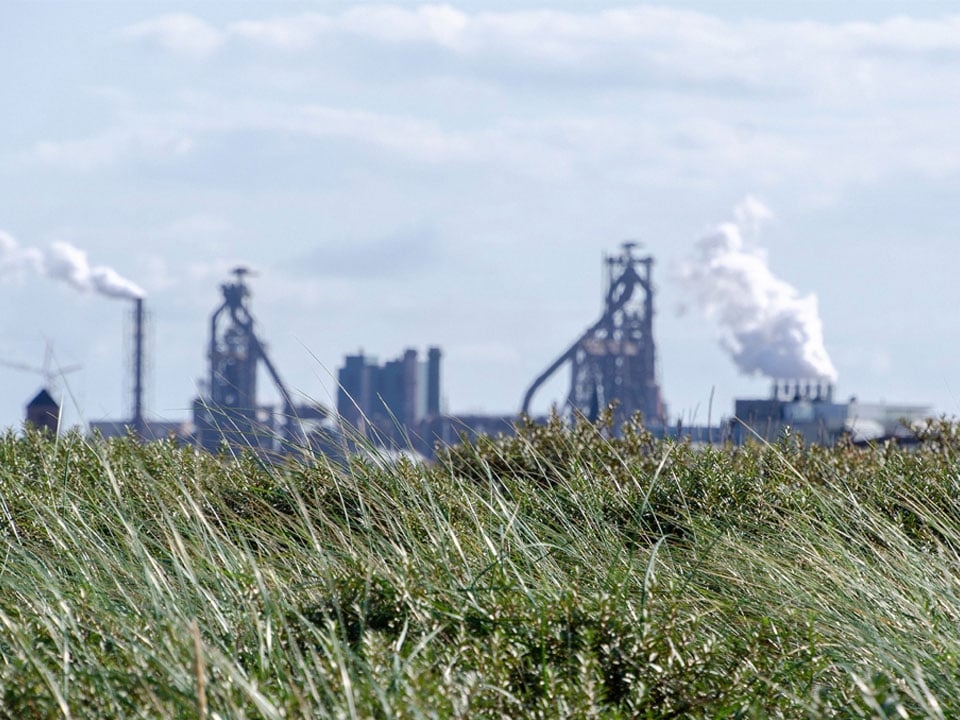
Cement is one of the world’s most important building materials, yet it is responsible for 8 per cent of globalCO₂ emissions. If this industry were a country, it would rank among the top five in terms ofCO₂ emissions. To radically reduce climate-damaging emissions, the Federal Institute for Materials Research and Testing is working on accelerating the development of sustainable cement formulations. Thanks to a web application developed by iteratec, which combines software engineering with artificial intelligence methods, research into climate-friendly cement formulations has now been made many times easier.

New approaches to more efficient research

Given the high levels ofCO₂ emissions associated with cement production, research into new formulations is essential. However, this is a highly challenging task, as variations in the formulation can have a significant impact on key factors such as the compressive strength of the concrete. Furthermore, laboratory tests are very time-consuming. AI methods were to be used to analyse existing data so that only the most promising formulations, possessing all the necessary material properties, would be tested in the laboratory. The technical expertise of iteratec was called upon for the further development of a prototype developed by BAM, because:

  • The experimental validation of formulations is expensive and time-consuming. AI models can therefore only draw on a limited amount of known measurement data, yet are still expected to deliver promising results.
  • Until now, the highly complex formulations had been maintained manually, which was a laborious process. The development of a digital laboratory twin was intended to create a fully automated and intuitive solution for enriching complex formulations with detailed knowledge with just a few mouse clicks.
Brand Icon_Cup
Brand Icon_Cup

The software, developed in collaboration with iteratec, is a technical innovation and holds great potential for the cement industry, which aims to become carbon neutral in Germany by 2050.

The solution: Sequential Learning meets Usability

The existing prototype was further developed and validated using state-of-the-art AI methods from iteratec. As traditional machine learning approaches are not suitable due to the large number of parameters involved in formulation – and the limited data set – sequential learning was employed here. The advantage is that it is possible to work with even a very small amount of data, which is gradually expanded through new laboratory tests. In this way, the algorithm is enriched with more data. Step by step, the quality of the predictions can thus be optimised through the interplay between machine learning on the one hand and laboratory experiments on the other.
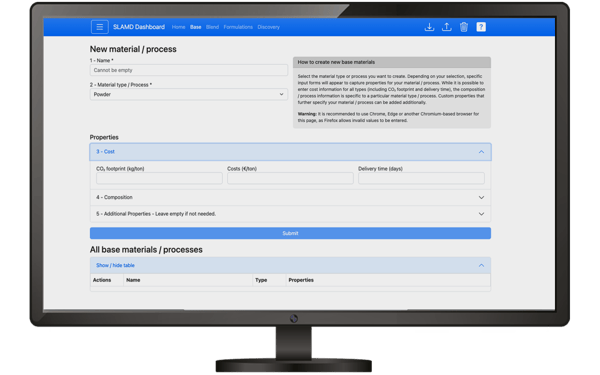
Screenshot of SLAMD

In order to make this solution available to laboratory staff for their work, the AI-Core was integrated into a completely new and openly accessible web application called SLAMD. This application includes a wide range of technically complex functions designed to test and visualise formulations based on different material compositions, thereby ensuring optimum compressive strength and lowCO₂ emissions .

The result: formulation research is significantly more efficient. Laboratory staff can develop alternative, climate-friendly cements more quickly and, consequently, more cost-effectively.

Digital Champions – that’s why

A free and open-source tool for research and industry

A first step towards an autonomous, fully automated laboratory

Universal applicability of the app for research into other building materials

As part of our project at the interface between applied AI research and materials science, our collaboration with iteratec has taken our research to a new level. The highly qualified team familiarised themselves with the complex scientific concepts remarkably quickly and translated these into a practical application in a targeted manner. This enabled us to develop a bespoke AI-supported software architecture right from the start, which has exceeded our expectations in every respect. The solution we developed together has the potential to fundamentally transform research into sustainable building materials.

Sabine Kruschwitz, Federal Institute for Materials Research and Testing

Your contact

Do you have a specific request or questions about possible AI and data analytics projects for your company? Send a request and we will get back to you.

Dr. Felix Böhmer, Director Al & Data Analytics
csm_teaser_locations_960x720_9d6e5eddb6

More Champion Stories